

 en
en
 English
 русский
 Español
 عربى
عربى ไทย
ไทยWhat is a Cleanroom Pass Through Window?
2026-07-06 - Last Updated: 2026-07-06
Content
- 1 Why Cleanrooms Rely On A Pass Through Window
- 2 Three Pass Through Window Types And Where Each One Fits
- 3 Kaisier Pass Through Window And Panel Series
- 4 Cabinet Construction And Material Specifications
- 5 Standard Dimensions And Installation Guidelines
- 6 Where Each Industry Draws The Line
- 7 Maintenance Schedule That Keeps The Seal Reliable
- 8 Quick Selection Checklist
A cleanroom pass through window is a sealed, dual-door transfer chamber built into the wall between a cleanroom and an adjacent space, used to move small and medium-sized items across a cleanliness boundary without opening the main entry door. Because only one door can open at a time, the interlocked chamber keeps the pressure differential intact and keeps outside particles from riding in on foot traffic. Facilities that install one typically see entry and exit trips drop by well over half, which is exactly why the device shows up in GMP, ISO 14644, and FDA-regulated environments as a required fixture rather than an optional extra.
Why Cleanrooms Rely On A Pass Through Window
Every time a person opens a cleanroom door to hand over a sample, a tool, or a box of components, the room loses a portion of its pressure cushion and gains a burst of ambient particles. A pass through window solves this by acting as an airlock sized for objects instead of people. One operator loads the chamber from the dirty side, closes that door, and only then can the clean-side door be released. The two doors are physically or electronically prevented from opening together, so the cleanroom envelope is never fully breached during a transfer.
This single mechanism has an outsized effect on contamination control. Facilities that rely purely on a swing door for material transfer report far higher particle counts near the entrance zone than facilities using a dedicated transfer window, simply because gowned personnel movement is the single largest source of particle generation in a controlled space.
Three Pass Through Window Types And Where Each One Fits
Selection starts with the interlock mechanism, since this determines both the cleanliness class the unit can support and the ongoing maintenance burden.
ISO 5 and above
Electronic Interlock
Electromagnetic locks and sensors manage the dual doors, typically reacting in under half a second. Premium units add LED status lights and fault alarms so operators know instantly which door is locked. This is the standard choice for high-grade cleanrooms where power availability is not a constraint.
ISO 7-8
Mechanical Interlock
A physical linkage or cam mechanism ties the two doors together without needing any electrical supply. Running costs stay low, but moving parts wear with use, so an annual function check on the interlock is the standard maintenance recommendation.
ISO 5-6
Self-Cleaning (Dynamic)
Adds a HEPA filtration unit and a UV sterilization lamp inside the chamber. A built-in blower circulates filtered air through the box at roughly 636 m³/h before the item is released, purging the chamber ahead of transfer. This variant is the preferred option for sterile labs and pharmacy compounding rooms.
| Type | Interlock Method | Typical Cleanliness Class | Extra Features |
| Electronic Interlock | Electromagnetic lock plus sensor | ISO 5 and above | LED indicator, fault alarm |
| Mechanical Interlock | Physical linkage or cam | ISO 7-8 | No power dependency |
| Self-Cleaning | Electronic or mechanical | ISO 5-6 | HEPA filtration, UV sterilization |
Kaisier Pass Through Window And Panel Series
Five configurations engineered around the same principle: keep the cleanroom envelope closed during every transfer, whichever interlock method or wall finish a project needs.
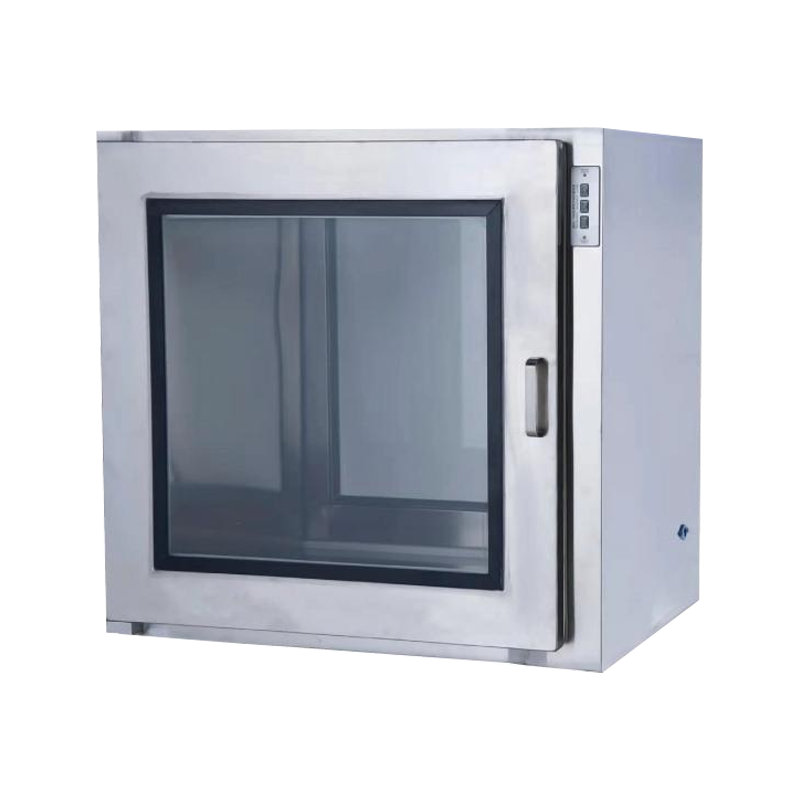
Electronic Interlock Pass Through Window
Pass Through Window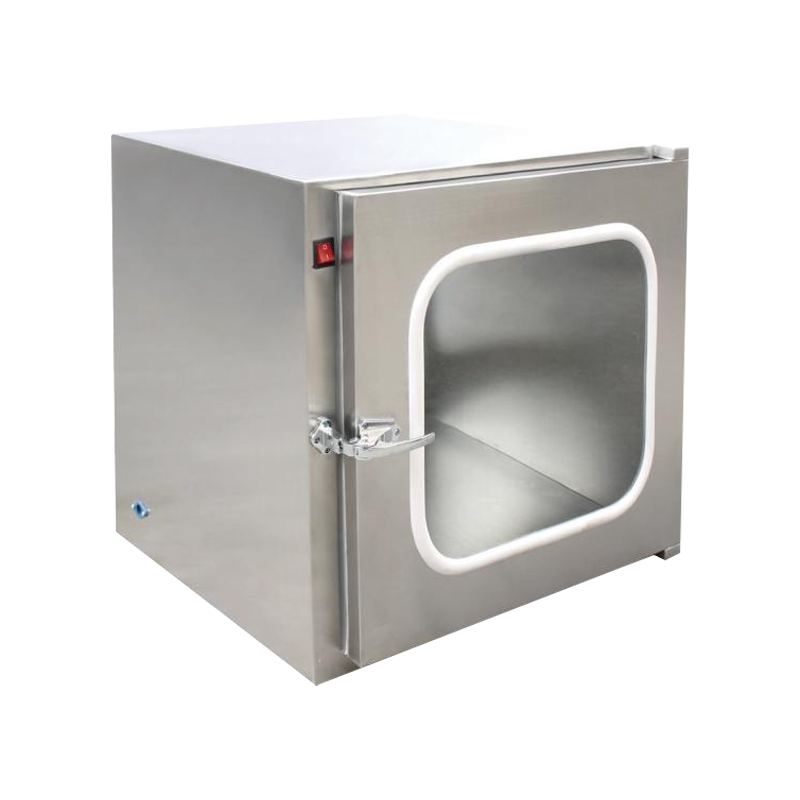
Mechanical Interlock Pass Through Window
Pass Through Window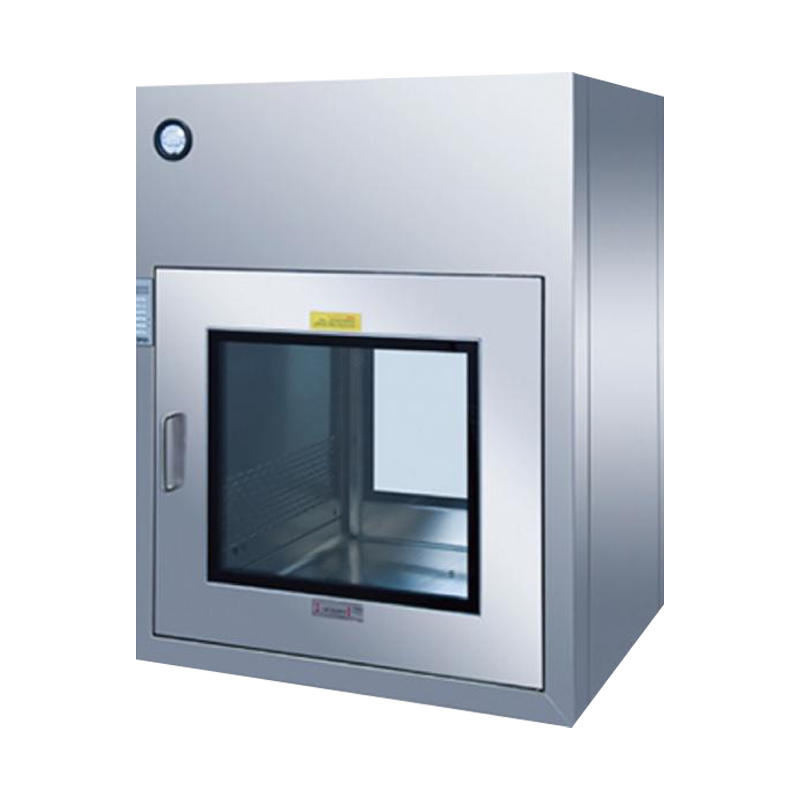
Self-Cleaning Pass Through Window
Pass Through Window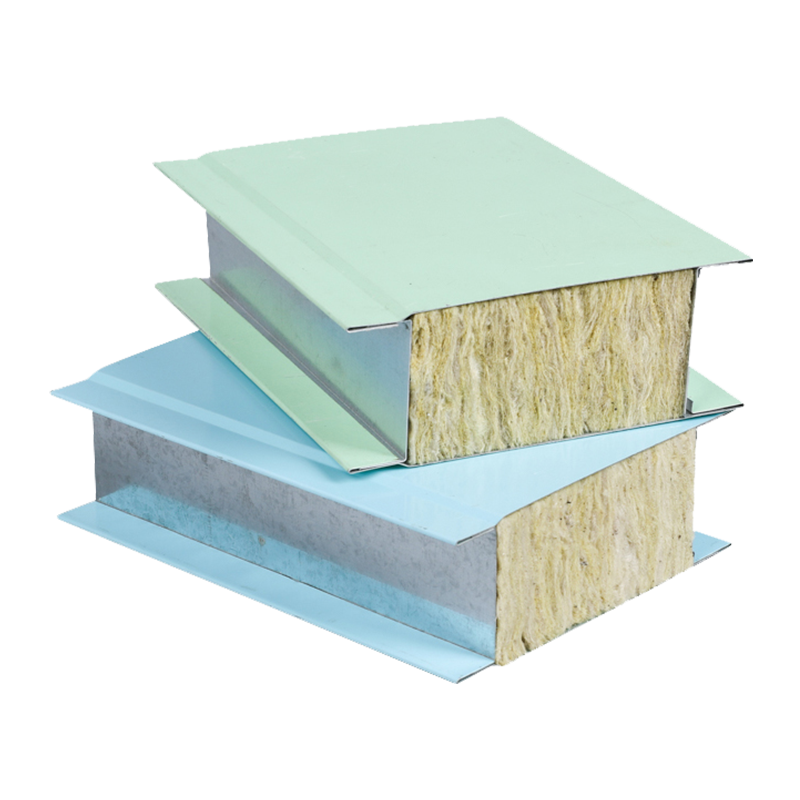
Machine-Made Rock Wool Cleanroom Panel
Cleanroom Panel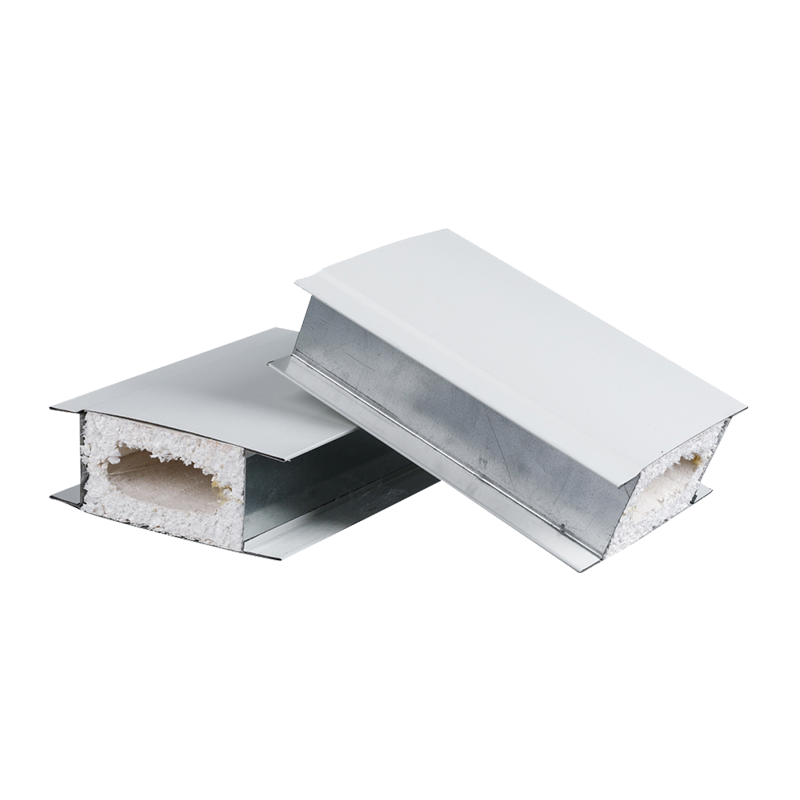
Machine-Made Magnesium Oxysulfate Cleanroom Panel
Cleanroom PanelCabinet Construction And Material Specifications
Performance comes down to what the box is built from and how the openings are sealed, not just which interlock is fitted.
- Cabinet body: SUS304 stainless steel covers most projects; SUS316L adds molybdenum for better resistance to chloride corrosion, which matters in hospital disinfection routines or coastal, high-salt sites. Standard wall thickness runs 1.2-1.5 mm with rounded internal corners of at least 10 mm radius to remove dead zones that trap residue. Powder-coated cold rolled steel is a lower-cost option for ISO 8 and below.
- Observation window: 5 mm tempered safety glass is the default; anti-static polycarbonate replaces it in ESD-sensitive electronics areas.
- Sealing system: Sanitary-grade silicone gaskets or polyurethane gel pads with a compression set under 15 percent keep leakage near zero under pressure differentials of plus or minus 30 Pa. Well-specified seals hold leakage rates below 0.01 percent.
- UV and filtration: Self-cleaning units carry 15-30 W UV lamps at 253.7 nm, delivering at least 40 mJ/cm² of irradiation to inactivate surface microbes. HEPA stages are rated H13 or H14, filtering 99.97 percent to 99.995 percent of 0.3 micron particles, with a differential pressure gauge to flag when resistance climbs to 2-2.5 times its starting value.
Standard Dimensions And Installation Guidelines
Sizing has to match wall thickness, the bulk of the materials being transferred, and how operators actually work at the opening.
| Model | Internal Width | Internal Height | Internal Depth | External Height |
| Standard Wall-Mounted | 610 mm | 610 mm | 305 mm | 741 mm |
| Medium Wall-Mounted | 914 mm | 914 mm | 610 mm | 1047 mm |
| Large Floor-Standing | 1067 mm | 1524 mm | 1372 mm | 1565 mm |
Leave the wall opening 5-10 mm larger than the outer frame for leveling and sealant. Mount the chamber 800-1000 mm above floor level for a comfortable working height. Seal the frame-to-wall gap with neutral silicone or EPDM gasket, and reserve a grounded power outlet nearby for any self-cleaning model.
Where Each Industry Draws The Line
Pharmaceuticals And Biotech
Transfers between Grade A/B and Grade C/D areas call for electronic interlocks paired with UV sterilization. In space-limited cell and gene therapy labs, compact wall-mounted units under 24 inches wide meet compliance without eating into usable cleanroom floor area.
Microelectronics And Semiconductors
Wafer fabrication and packaging lines typically target ISO Class 5, favoring anti-static polycarbonate windows to avoid electrostatic discharge damage. Some lines add nitrogen purge ports to push particle and oxygen levels down further.
Hospitals And Food Processing
Operating rooms and central sterile supply departments need SUS316L bodies that tolerate high-temperature steam sterilization and chemical disinfectants. Food processing sites generally satisfy HACCP requirements with a mechanical interlock at ISO Class 8.
Maintenance Schedule That Keeps The Seal Reliable
A pass through window is only as good as its upkeep. A neglected unit becomes a contamination leak that is arguably worse than having no barrier at all, since staff assume it is doing its job.
- Daily: Check gasket condition, wipe the observation window, confirm the interlock still engages correctly.
- Weekly: Clean interior walls with alcohol or a neutral detergent; check UV lamp output and replace once it drops below 70 percent of rated intensity.
- Quarterly: Run a photometer or DOP/PAO aerosol test on the HEPA filter; scan leakage should stay under 0.01 percent.
- Annually: Bring in a third party for pressure differential retention testing and full interlock calibration; pressure drop should stay within 5 percent over 15 minutes.
Quick Selection Checklist
01
Confirm the target ISO class first, since it narrows the interlock type before anything else is decided.
02
Match cabinet material to the disinfection routine — 316L for steam and harsh chemicals, 304 for general use.
03
Size the internal clearance around the largest routine item, not the average one.
04
Add HEPA and UV only where sterility risk justifies the extra maintenance load.
05
Confirm power and grounding availability at the wall location before ordering a self-cleaning unit.
A pass through window earns its place in a cleanroom by doing one job extremely well: moving items across a pressure boundary without ever fully opening it. Getting the interlock type, cabinet material, and seal specification right at the selection stage is far cheaper than correcting a leak path after installation, so it pays to size the decision around the actual cleanliness class and disinfection routine the room will run day to day.
Message Feedback
Product Categories
Easily navigate and discover our complete range of solutions through our logically structured product
categories.



- E-Mail: [email protected]
- Tel: +86 18968239620
- Address: Room No.905, He Yuan Mansion, No. 382, Tianda Lane, Ningbo Southern Business District, Yinzhou Ningbo China
Quick Links
Contact Us
© Copyright Zhejiang Kaisier Clean Technology Co.,Ltd.
All Rights Reserved.
 Cleanroom Systems Manufacturer
Modular Cleanroom Solutions Factory
Cleanroom Systems Manufacturer
Modular Cleanroom Solutions Factory
-
+86 18968239620
-
-
