

 en
 English
 русский
 Español
 عربى
 ไทย
Cleanroom Pass-Through Window Guide: Dynamic vs Static Systems Compared
2026-10-23 - Last Updated: 2026-10-23
Content
- 1 Two Words, Two Air Strategies
- 2 Static Pass-Through Window: Passive Isolation, No Moving Parts
- 3 Dynamic Pass-Through Window: The Self-Cleaning Cycle
- 4 Static vs Dynamic Pass-Through: Side by Side
- 5 The Specifications That Actually Decide Your Order
- 6 Buying Checklist and the Mistakes That Cost the Most
- 7 Installation, Commissioning and Maintenance
- 8 FAQ
You are standing outside the cleanroom with a loaded tray in your hands. Open the door, set the tray down, close it, and someone on the far side takes it away. It sounds trivial, right up until you have to choose between a static and a dynamic cleanroom pass-through window. The short answer: if the two rooms sit at the same differential pressure and you are moving bagged or boxed items, a static unit is enough. The moment either room runs at a higher pressure or a stricter ISO class, or you are handling open containers and sterile components, you want the dynamic, self-cleaning version.
Two Words, Two Air Strategies
Both products sit in a wall opening and both have a door at each end, so the two spaces never connect directly. What separates them is the air inside the cavity. A static pass-through window is a sealed box with no moving parts: it isolates, and nothing more. A dynamic unit adds a small fan, a HEPA filter and a timed scrubbing cycle, so the cavity cleans itself between transfers. Note that "dynamic" describes the airflow, not the door — both types have two doors.
Static Pass-Through Window: Passive Isolation, No Moving Parts
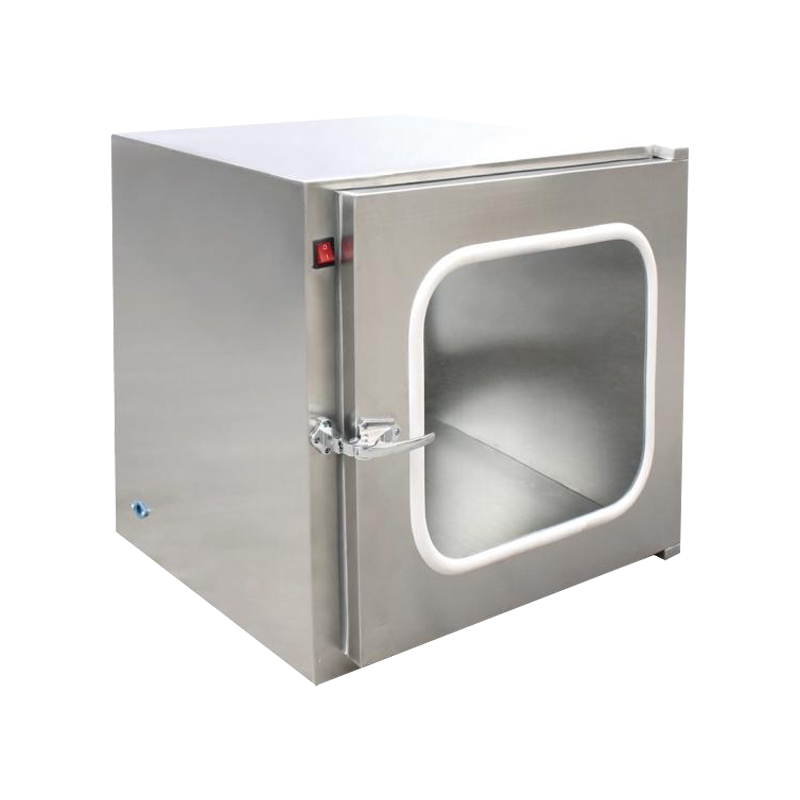
A static unit is a stainless steel or powder-coated box with two doors, an interlock and a glazed panel so operators can see what is inside. The interlock is either mechanical, using a linkage that physically blocks the second door, or electromagnetic, using a solenoid and a sensor pair. Mechanically interlocked units need no power at all, which is why they still dominate older facilities and any wall where running a cable is awkward.
What a static box does not do is clean the air. Each time a door opens, the cavity exchanges air with the room it faces, and whatever particulate arrived with that air stays until the adjacent cleanroom's own air changes dilute it. That is fine when the two spaces are close in pressure and cleanliness, and when the goods are double-bagged or sealed. It is not fine when the cavity straddles a real pressure boundary.
The working limit most specifiers use is a differential of roughly 5 to 10 Pa between the two rooms. Beyond that, pressure pushes against the door seals, and a seal that leaks is a leak path straight into your classified area. If your wall separates a 15 Pa cleanroom from a 0 Pa corridor, this is the wrong product, however attractive it looks on the quotation.
Dynamic Pass-Through Window: The Self-Cleaning Cycle
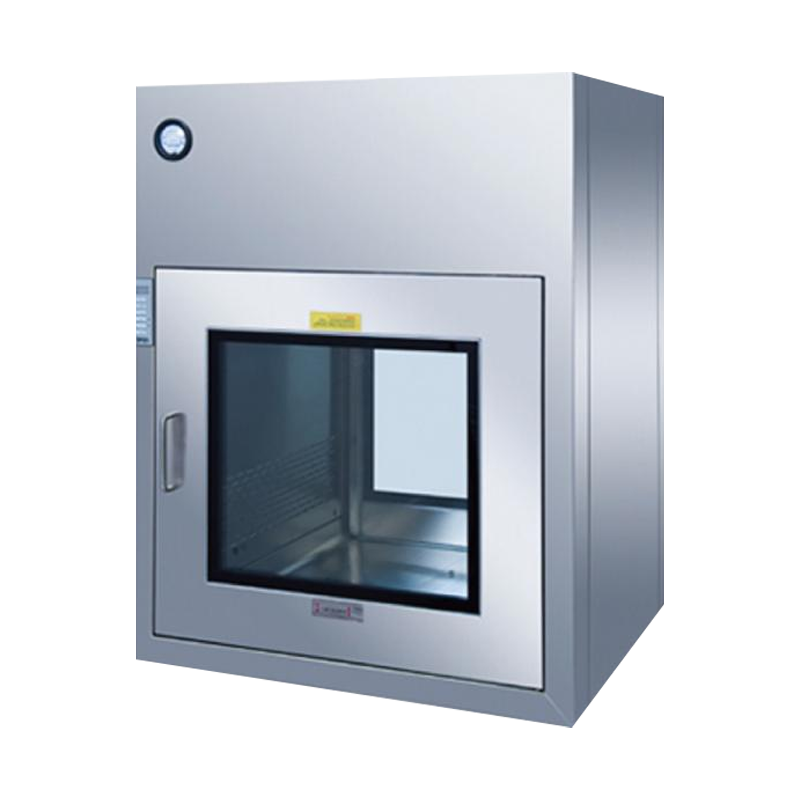
A dynamic unit is a static box with a miniature fan filter unit built into the top or the rear. Cavity air is drawn through an H13 or H14 HEPA filter and returned, so the interior reaches something close to ISO Class 5 (Class 100) conditions during the cycle. Cycle time is usually adjustable; suppliers commonly ship a default around 99 seconds, while short 10 to 30 second cycles suit small, lightly loaded transfers.
Because the unit generates its own airflow and pressure, it tolerates exactly the conditions that defeat a static box. If the two rooms differ in pressure, or one side is a lower-class corridor and the other is a filling suite buffer, the dynamic unit still keeps the cavity under control. It also gives you instruments to prove it: a differential pressure gauge across the HEPA filter, a timer, and on better units an airflow sensor with an alarm.
The trade-offs are real. You need a power drop and a control cable, the HEPA filter is a scheduled consumable, the fan is a wear item, and in a sterile or regulated area you will likely have to qualify airflow velocity (0.45 m/s with roughly plus or minus 20 percent is a common target) and filter integrity. Budget two to four times the price of a comparable static unit, plus the electrical work.
Static vs Dynamic Pass-Through: Side by Side
| Criteria | Static pass-through | Dynamic pass-through |
|---|---|---|
| Air handling | None; sealed dead volume | Built-in fan with HEPA-filtered recirculation |
| Cavity cleanliness | Follows the adjacent rooms; typically around ISO 7 to 8 | Reaches Class 100 or ISO 5 conditions during the cycle |
| Door control | Mechanical or electromagnetic interlock | Usually electronic interlock with timer and cycle confirmation |
| Pressure tolerance | Poor above roughly 5 to 10 Pa difference | Designed for rooms running at different pressures |
| Best fit | Similar pressures, wrapped or boxed goods | Open containers, sterile parts, grade changes |
| Power requirement | None for mechanical interlock; 24 V DC for solenoid type | Required for fan and controller |
| Maintenance items | Door seals, interlock, optional UV lamp | Door seals, interlock, HEPA filter, fan, pressure gauge |
| Relative cost | Baseline | Roughly two to four times higher |
| Qualification effort | Low | Higher: velocity, filter integrity, self-clean time |
The Specifications That Actually Decide Your Order
Price follows these seven decisions, so settle them before you ask for quotations. If you are still mapping the enclosure around the opening, our cleanroom system selection guide covers panels, doors, windows and filters in the same sequence.
- Cavity size. Size against your largest tray or tote, not the average one. A 500 x 500 x 500 mm cavity is a common starting point; 800 mm and custom sizes accommodate carts.
- Wall thickness. Cleanroom panels of 50, 75 and 100 mm need different frame depths. Reserve the opening to the manufacturer's drawing instead of cutting on site.
- Material and finish. 304 or 316L stainless steel, continuously welded, with radiused corners, an internal roughness typically between Ra 0.8 and 1.5 micrometres, and no exposed fasteners.
- Differential pressure. Above roughly 10 Pa across a static unit, either switch to dynamic or add pressure relief.
- Filter class. H13 versus H14 changes how fast the cavity recovers and what your replacement cost looks like.
- Interlock logic. Mechanical linkage, electromagnetic lock, or a PLC with adjustable cycle time and cycle-complete signal.
- Verifiability. Gauge position, a sampling port for velocity, and an agreed self-clean time target.
Buying Checklist and the Mistakes That Cost the Most
Work through the list below in order; the first two items cause most of the rework we see on site.
- Measure the largest load, not the average load, and add clearance for gloved hands.
- Confirm the structural opening and the panel thickness on a drawing before the order is placed.
- Decide the interlock type, then plan the power and interlock cable route while the wall is still open.
- Ask for the HEPA filter grade certificate and the measured airflow velocity, not just a datasheet claim.
- Fix the steel grade and surface roughness in the contract so there is no argument at delivery.
- Confirm spare parts: door gaskets, HEPA elements, fan assemblies and control boards.
- Agree who performs commissioning and what the acceptance record contains.
The most expensive mistake is specifying a static unit between two rooms with a 15 Pa difference, then trying to solve it with a thicker gasket. Pressure wins that argument. The second most expensive is bolting a dynamic unit onto a finished wall months after handover, which means either cutting the enclosure or running surface conduit across a panel that was built to be smooth. Finally, many dynamic units are purchased without a filter replacement plan; three years later a cavity that once behaved like ISO 5 is just an expensive static box.
Installation, Commissioning and Maintenance
Send your wall thickness, opening size and pressure readings to our team and you will get a drawing back with the cut-out dimensions marked. Once the units arrive, the following sequence keeps surprises to a minimum.
At installation
- Form the opening to the manufacturer's drawing; never cut a finished panel to fit the unit.
- Seal the frame to the panel with neutral silicone and cleanroom aluminium profiles, keeping the internal face flush.
- Check that the two doors can never be open at the same time, mechanically and electrically.
Before handover
- Measure and record airflow velocity on dynamic units.
- Run a filter integrity check and record the pressure drop across a clean filter as your baseline.
- Time a full self-clean cycle against the agreed figure.
On the maintenance schedule
- Door gaskets: inspect quarterly, replace when they harden or crack.
- HEPA filters: replace on gauge reading or on a 12 to 24 month cycle.
- Fans: clean the impeller and listen for bearing noise at each service.
- Cavities: wipe with a stainless-compatible cleaner; avoid chlorine-based products.
- UV lamps, if fitted: output decays with use, so replace around 8,000 to 9,000 hours.
FAQ
Can I use a static pass-through between an ISO 8 and an ISO 7 room?
Yes, provided the pressure difference between the two rooms stays small, roughly within 5 Pa, and the goods are wrapped. If the ISO 7 room runs at a noticeably higher pressure, the seal is being pushed the wrong way and a dynamic unit is the safer specification.
Does a dynamic pass-through still need a UV lamp?
UV light only reaches surfaces in direct line of sight, so it leaves shadows untreated. The HEPA scrubbing cycle does the main work; a UV lamp, where fitted, is an additional measure between cycles rather than a substitute for filtration.
How long does one self-clean cycle take?
It depends on cavity volume and load. A small, lightly loaded cavity can recover in 10 to 30 seconds, while a fully loaded 800 mm unit is often set to a 99 second default. Verify the figure against your own load rather than accepting a catalogue number.
How large should the wall opening be?
Follow the manufacturer's drawing. A unit with a 500 mm internal cavity typically needs a rough opening of about 600 to 700 mm, and the panel thickness determines the frame depth and the final trim detail.
Do dynamic units need qualification?
In sterile or regulated areas, usually yes. The record normally covers airflow velocity, HEPA filter integrity, and the self-clean time needed to bring the cavity back to its target condition after a transfer.
If you take one idea away, make it this: the decision is settled by the pressure boundary, not by the price list. A static pass-through window performs genuinely well when both rooms sit at similar pressure and the goods are protected. Anything beyond that, and the fan, filter and timer inside a dynamic unit are what keep your classified area classified.
Message Feedback
Product Categories
Easily navigate and discover our complete range of solutions through our logically structured product
categories.



- E-Mail: [email protected]
- Tel: +86 18968239620
- Address: Room No.905, He Yuan Mansion, No. 382, Tianda Lane, Ningbo Southern Business District, Yinzhou Ningbo China
Quick Links
Contact Us
© Copyright Zhejiang Kaisier Clean Technology Co.,Ltd.
All Rights Reserved.
 Cleanroom Systems Manufacturer
Modular Cleanroom Solutions Factory
-
+86 18968239620
-
-
